Product Designer & Full Stack Developer
LifeHub — Personal Life Management Platform
A modular platform bringing family coordination, life admin, household management, career tracking, fitness and family goals into one calm home base.
Next.js · TypeScript · Authentication · PWA · Responsive Design · Privacy by Design
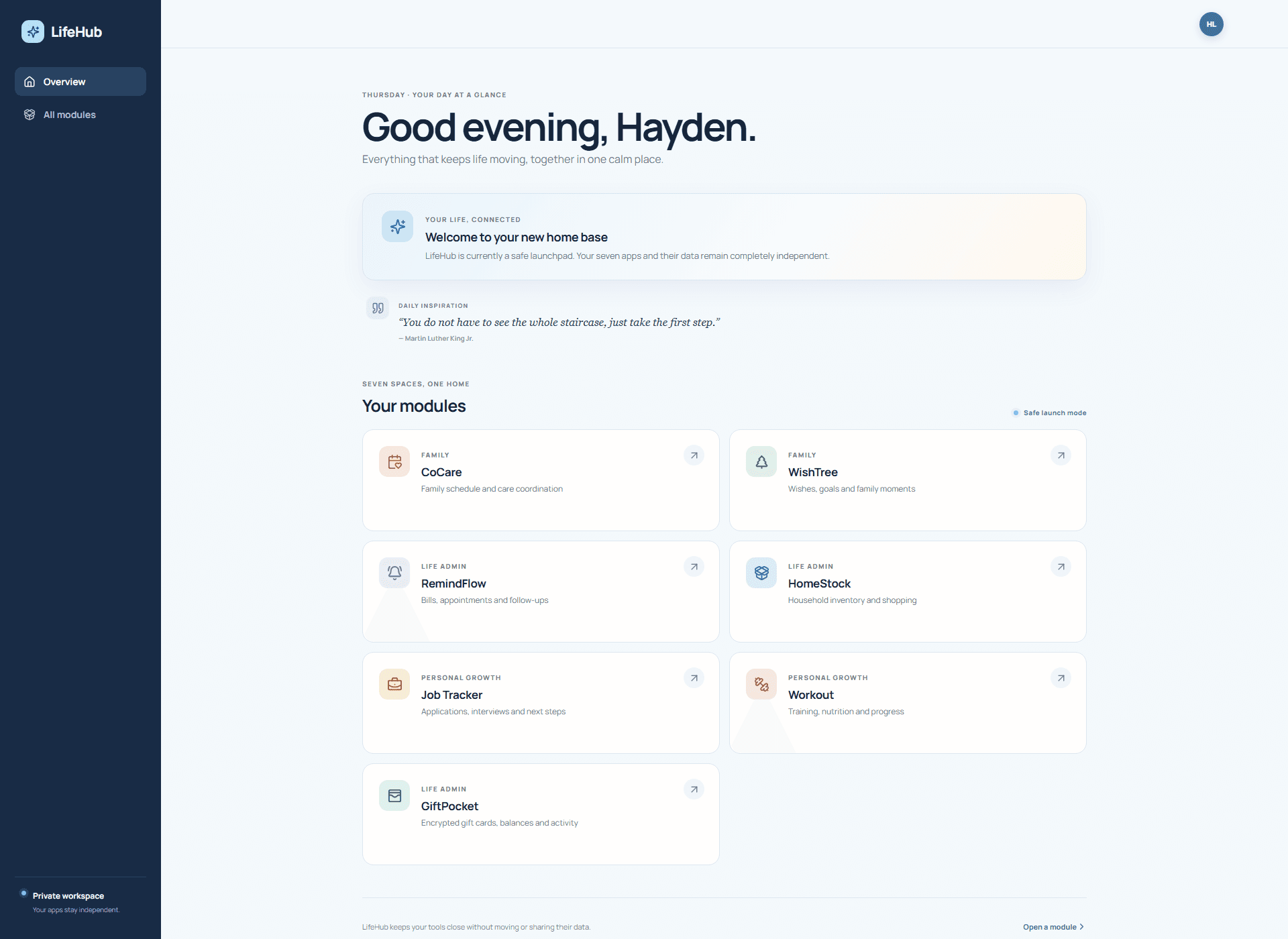
Private dashboard · Select a thumbnail to explore the interface
Overview
LifeHub is a personal and family management platform I designed around real everyday workflows. It brings seven independent applications into one consistent experience while deliberately keeping sensitive data and production systems isolated.
The first release is a secure launchpad rather than a risky rewrite. Each module remains independently deployable, retains its own database and access controls, and can still be opened directly if LifeHub is unavailable.
The problem
Important information was spread across messages, calendars, notes and separate tools. Generic productivity software did not reflect the actual workflows involved, while combining every system too early would have introduced unnecessary migration and privacy risk.
The solution
I created a private, installable dashboard with a consistent navigation system and seven purpose-built modules:
- CoCare — shared parenting schedules, change requests and care coordination.
- RemindFlow — bills, subscriptions, appointments and follow-up reminders.
- HomeStock — household inventory, low-stock visibility and shopping management.
- ApplyTrackr — job applications, interviews and follow-up actions.
- Workout — training, nutrition, calendars and progress tracking.
- WishTree — family wishes, goals and shared moments.
- GiftPocket — encrypted gift cards, balances, expiry dates and purchase activity.
Architecture decision
Instead of immediately merging seven codebases and databases, LifeHub uses progressive integration:
- A unified private entry point with independent module links.
- A shared visual language across modules.
- Read-only summaries and a cross-module Action Center in later releases.
- Shared authentication or data services only where they provide a clear benefit.
This approach protects working production systems, keeps failures isolated and allows every module to evolve independently.
Privacy and security
- LifeHub has its own server-validated password and HTTP-only session cookie.
- Module credentials and database connections are never passed through LifeHub.
- Production and portfolio data remain separate.
- Public case studies use synthetic screenshots rather than real accounts.
- Original module URLs remain available if the hub is offline.
Product experience
The dashboard uses a calm light-blue and warm-neutral visual system. It is responsive, installable on iOS and Android, supports standalone display and includes a daily rotating inspirational quote without external tracking.
What I learned
- Design a platform around real workflows instead of isolated CRUD screens.
- Balance product unification with operational safety.
- Treat authentication boundaries and privacy as part of product design.
- Use staged migration to deliver value without disrupting active systems.